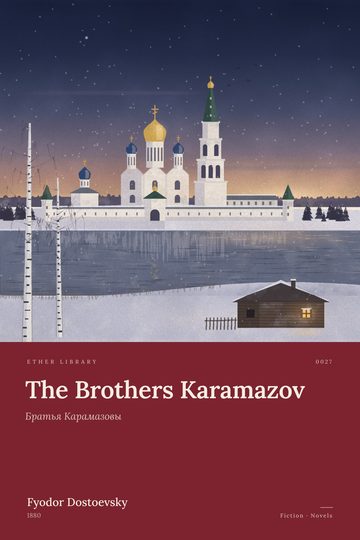
The Brothers Karamazov
Братья Карамазовы
EditionTranslated from the original Russian (Wikisource modern-orthography text)
A dissolute father, three different sons, one woman, three thousand rubles, and the question: if there is no God, is everything permitted?
Also in the library: the complete Korean translation.
Anyone can read the first chapter. Join free to read to the end and download EPUB and PDF.
DRM-free files. Translation CC BY-NC 4.0; the original work is in the public domain.
About the book
In a small Russian district town lives Fyodor Pavlovich Karamazov, a landowner who started with next to nothing and made money, a sensualist who calls himself an old buffoon. He left the three sons of his two marriages to be brought up by others. Now, grown, they come home one after another: Dmitri, a hot-tempered retired officer who is free with money; Ivan, a cold, brilliant writer; and Alyosha, twenty, a novice at the town monastery under the elder Zosima.
Dmitri quarrels with his father over his mother’s inheritance, and father and son want the same woman, Grushenka. Dmitri owes three thousand rubles to his fiancée, Katerina Ivanovna, and in his father’s house lies an envelope of three thousand rubles, sealed and inscribed “To my angel Grushenka, if she will come.” Ivan tells Alyosha that if there is no God, everything is permitted, and recites his poem “The Grand Inquisitor”; Alyosha writes down the dying elder’s last teachings. Then one night there is blood in the house, and the story moves from the monastery to a drunken night at a country inn, an all-night interrogation, and a courtroom the whole country is watching.
This complete English translation is made directly from Dostoevsky’s Russian. Russians call one person by many names, Alexei Fyodorovich, Alyosha, Alyoshka, Alyoshenka, and the choice is the distance between two people at that moment, so the English keeps the form the Russian uses in each place. Where a character moves between the formal and the familiar “you,” the English changes its register in that very sentence.
The narrator is a provincial chronicler of “our town,” and every “it seems” and “they say” of his is kept, as are the repetitions and breathless sentences of Dostoevsky’s people. The book’s key words, “strain,” “everything is permitted,” “all are guilty for all,” stay the same from beginning to end. Each of the 5,063 paragraphs of the Russian is one paragraph here, with fourteen short translator’s notes.
Highlights
- It isn’t God that I don’t accept, Alyosha, I am only most respectfully returning him the ticket.
- The suffering of being no longer able to love.
- Oh, children, oh, dear friends, don’t be afraid of life! How good life is when you do something good and true!
Contents
Anyone can read up to the first chapter. Chapters with a lock are open to free members.
Colophon
Translated from the original Russian (Wikisource modern-orthography text). Licensed CC BY-NC 4.0.Full colophon
The Brothers Karamazov
Original title · Братья Карамазовы. Роман в четырех частях с эпилогом (a novel in four parts with an epilogue)
Author · Fyodor Mikhailovich Dostoevsky (1821–1881)
Translator · Ether Library
First publication · Russky Vestnik (The Russian Messenger), Moscow, 1879–1880; first book edition in two volumes, 1880.
Source text · The public-domain Russian text in modern orthography published by Russian Wikisource. Translated directly from the Russian. Constance Garnett’s translation (1912) was consulted only to check the meaning, as far as Book Twelve, chapter four.
Extent · Complete and unabridged · dedication, From the Author, four parts in twelve books with ninety-three chapters, and an epilogue of three chapters · 5,063 paragraphs, as in the source · 14 short translator’s notes
Copyright · The author died in 1881; the original work is in the public domain.
This translation · Translated from the Russian by Ether Library. The English text is © Ether Library and is licensed under Creative Commons Attribution-NonCommercial 4.0 International (CC BY-NC 4.0): you may copy and share it for noncommercial purposes, with attribution.
Edition · English edition 1.0 · November 2026
Typography · Set in Lora (SIL Open Font License 1.1). Cover painting and design by Ether Library.
Original in the public domain · English translation CC BY-NC 4.0
Ether Library · No. 0027