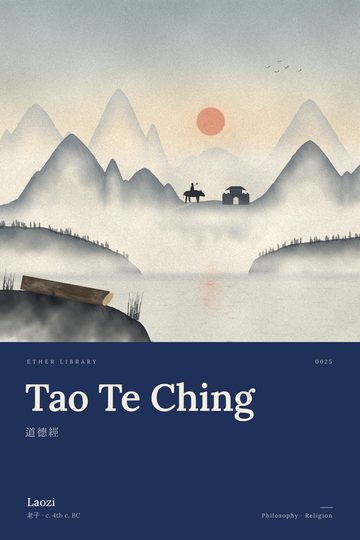
Tao Te Ching
道德經
EditionTranslated from the original Classical Chinese (Wang Bi recension family, with the Chinese text)
Eighty-one short chapters on the Way: water that overcomes stone, the sage who does nothing, and the name that cannot be named.
Also in the library: the complete Korean translation.
Anyone can read the first chapter. Join free to read to the end and download EPUB and PDF.
DRM-free files. Translation CC BY-NC 4.0; the original work is in the public domain.
About the book
As the Zhou dynasty declined, the story goes, Laozi, keeper of the royal archives, left the world and rode west. At the frontier pass the gatekeeper begged him for his teaching, and he wrote some five thousand characters and went on. That short book is the Tao Te Ching. For more than two thousand years it has been read by rulers, poets, and recluses across East Asia, and it is now one of the most translated books in the world.
Its eighty-one chapters are brief and mostly paradox. The highest good is like water; the soft overcomes the hard; great skill seems clumsy; the sage does nothing, yet nothing is left undone. It has been read as a book on governing, on keeping the body whole, and on stilling the mind.
This complete English translation is made directly from the Classical Chinese of the received text, of the Wang Bi recension family. Each chapter prints the Chinese first, one clause to a line, and the English line for line beneath it. The key terms keep one rendering throughout, and seventeen short notes mark old customs and the places where our text differs from Wang Bi’s.
Highlights
- The highest good is like water.
- Those who know do not speak; those who speak do not know.
- Heaven’s net is wide, so wide; its mesh is coarse, yet nothing slips through.
Contents
Anyone can read up to the first chapter. Chapters with a lock are open to free members.
Colophon
Translated from the original Classical Chinese (Wang Bi recension family, with the Chinese text). Licensed CC BY-NC 4.0.Full colophon
Tao Te Ching
Original title · 道德經 Daodejing, also called the Laozi 老子
Author · Laozi (traditionally of the Zhou court; life and dates uncertain)
Translator · Ether Library
Composition · Fourth century BC or somewhat earlier. The eighty-one chapters, in the Book of the Way (1–37) and the Book of Virtue (38–81), took their standard form in the text annotated by Wang Bi (226–249).
Source text · A public-domain digital transcription of the received eighty-one-chapter text, of the Wang Bi recension family. Translated directly from the Classical Chinese. James Legge’s English translation, The Tao Teh King (Sacred Books of the East 39, Oxford, 1891), was consulted for meaning only.
Extent · Complete and unabridged · 81 chapters · 5,301 characters of Chinese (punctuation excluded), printed in full in 572 lines, each with its English line · 17 short translator’s notes
Corrections · Characters miswritten in restoring simplified forms, two blank characters (chapter 20), and two misprints (chapter 64) are corrected in the Chinese. Readings that differ from Wang Bi’s text and change the sense are kept as in our source and noted.
Copyright · The original work dates from before the common era and is in the public domain everywhere. The transcription adds no rights, and Legge’s translation of 1891 is in the public domain.
This translation · Translated from the Classical Chinese by Ether Library. The English text is © Ether Library and is licensed under Creative Commons Attribution-NonCommercial 4.0 International (CC BY-NC 4.0): you may copy and share it for noncommercial purposes, with attribution.
Edition · English edition 1.0 · November 2026
Typography · Set in Lora (SIL Open Font License 1.1); the Chinese in Noto Serif CJK (SIL Open Font License 1.1). Cover painting and design by Ether Library.
Original in the public domain · English translation CC BY-NC 4.0
Ether Library · No. 0025